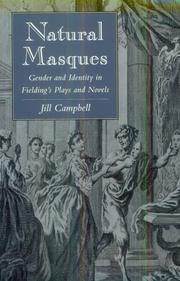
An edition of Natural masques (1995)
Natural masques
gender and identity in Fielding's plays and novels
By Jill Campbell
Publish Date
1995
Publisher
Stanford University Press
Language
eng
Pages
324
Description:
Examining Henry Fielding's sustained, often ambivalent engagement with questions of gender, Natural Masques breaks with old critical commonplaces that contrast Fielding's "masculinity" with Samuel Richardson's "feminine" sensibilities. It argues that a preoccupation with the tenuousness of gendered identity appears throughout Fielding's writings, and that Fielding shared that preoccupation with his contemporaries. It therefore offers an argument about Fielding's period as well as about his major works, which are analyzed in connection with a variety of related texts - from satires on the castrati to educational treatises, Whig propaganda, and debates in political theory. Approaching gender as a complex system of relations, Campbell investigates Fielding's treatments of masculine and feminine identities across the arenas of eighteenth-century political, social, and literary conflict and change. The plays with which Fielding began his literary career are particularly explicit concerning his interest in problems of gender. Some of their most recurrent satiric targets - domineering women, castrato singers, beaux - disrupt the expected economy of sexual roles, and Fielding's productions of his own plays often featured the dramatic spectacle of this disruption, with men cast in women's roles, and women in men's. In the opening scenes of Joseph Andrews, Fielding frames his parodic response to Pamela by reversing the sexes of the two participants in Richardson's scenario of embattled chastity. Campbell shows how throughout Fielding's writings, the suspicion that sexual roles are merely assumed - and therefore subject to alteration and appropriation - intimates a more general possibility that personal identity is always in some sense impersonated, incoherent, mutable. . Campbell draws on recent work that sees the eighteenth century as a crucial moment in the history of sexuality and gender, and she critiques new treatments of the novel's function in defining domestic femininity.
subjects: Masculinity in literature, Identity (Psychology) in literature, Knowledge, Psychological fiction, American, Psychological aspects of Drama, History and criticism, Sex role in literature, American Psychological fiction, Drama, Masculinity (Psychology) in literature, Psychology, Femininity in literature, Femininity (Psychology) in literature, Fielding, Henry, 1707-1754, Gender identity in literature, Psychological aspects, Psychology in literature, Knowledge and learning
People: Henry Fielding (1707-1754)