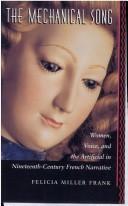
An edition of The mechanical song (1995)
The mechanical song
women, voice, and the artificial in nineteenth-century French narrative
By Felicia Miller Frank
Publish Date
1995
Publisher
Stanford University Press
Language
eng
Pages
223
Description:
Examining the seemingly privileged relation of women to the singing voice in nineteenth-century literary works, the author argues for an emerging identification between women and artifice in the period, stemming from Baudelaire's watershed contribution to the theory of art in modernity - his association of art with artifice. Beginning with texts by Rousseau and Proust that show a link between nostalgia for the maternal voice and the writer's self, the book then turns to the psychoanalytic literature on the role of the voice in the formation of the psyche. In the process, it analyzes feminist polemics on the maternal voice to show how voice and rhythm together form the matrices of the subject. . The voice of the soprano occupied a special place in nineteenth-century operatic history, replacing the castrato voice as a sexless, angelic, ethereal source of pleasure for the opera-goer. The author shows how these qualities are identified with women's voices in literary texts by Sand, Balzac, du Maurier, and Nerval, and how they are also represented as constructed and artificial. With Baudelaire's valuation of artifice, such an identification of women with artifice resonates with an emergent modernist aesthetic that abandons the imitation of nature in favor of a valorization of artifice. Villiers de l'Isle-Adam's L'Eve future expresses this aesthetic, together with anxieties and fantasies about the technological innovation of the Edison phonograph and an anticipation of certain themes of avant-garde cinema. . The author's historical and psychoanalytical accounts come together in a final chapter which shows that the female voice conveys the sense of sublime experience.
subjects: History, History and criticism, Technology in literature, Voice in literature, Literature and technology, French literature, Women singers in literature, Narration (Rhetoric), Women and literature, Singing in literature, Littérature française, Histoire et critique, Littérature et technologie, Histoire, Femmes et littérature, Chanteuses dans la littérature, Technologie dans la littérature, Chant dans la littérature, Voix, Narration, Erzählung, Französisch, Frau, Literatur, Stimme, Technik, Frauenstimme, Stem, Vrouwen, Estheticisme, Sekserol, Literatuur, Psychoanalytische interpretatie, French literature, history and criticism, 19th century
Places: France
Times: 19th century