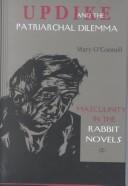
An edition of Updike and the patriarchal dilemma (1996)
Updike and the patriarchal dilemma
masculinity in the Rabbit novels
By O'Connell, Mary
Publish Date
1996
Publisher
Southern Illinois University Press
Language
eng
Pages
268
Description:
O'Connell examines the role of socially constructed masculinity in Updike's Rabbit tetralogy - Rabbit Run, Rabbit Redux, Rabbit Is Rich, and Rabbit at Rest - convincingly arguing that the four novels comprise the longest and most comprehensive representation of masculinity in American literature and place Updike firmly with the precursors of the contemporary movement among men to reevaluate their cultural inheritance. A disturbing element exists, O'Connell determines, in both the texts of the Rabbit novels and in the critical community that examines them. In the novels, O'Connell finds substantial evidence to demonstrate patterns of psychological and physical abuse toward women, citing as the culminating example the mounting toll of literally or metaphorically dead women in the texts. Critics who view Updike as a nonviolent writer and strangely overlook Rabbit's repressive and violent behaviors avoid a discomforting but crucial aspect of the characterization. Although she examines negative aspects of Rabbit's behavior, O'Connell avoids the oversimplification of labeling Updike a misogynist. Instead, she looks closely at the forces shaping Rabbit's gender identity as well as at the ways he experiences masculinity and the ways his gender identity affects his personal and spiritual development, his relationships, and, ultimately, his society. As she discusses these issues, O'Connell uses the term patriarchy in its broadest sense to refer to the practice of centralizing the male and marginalizing the female in all areas of human life. Patriarchal ideology - the assumptions, values, ideas, and patterns of thought that perpetuate the arrangement - is written as hidden text, permeating every aspect of culture, particularly language, from which it spreads to other signifying systems. Contrary to conventional critical wisdom, the Rabbit tetralogy is not a straightforward chronicle; the novels create meaning by challenging, undermining, and qualifying their own explicit content. Updike claims that his novels are "moral debates with the reader," and according to O'Connell, the resisting reader, active and skeptical, is the one most likely to register the nuances and the shifting currents of the discourse.
subjects: Characters, Masculinity in literature, Patriarchy in literature, Harry Angstrom (Fictitious character), Harry Angstrom, Men, Men in literature, Hommes, Personnages, Et la psychologie, Masculinite dans la litterature, American, LITERARY CRITICISM, Patriarcat dans la litterature, Updike, john, 1932-2009, Angstrom, harry (fictitious character), Patriarcat dans la littérature, Masculinité dans la littérature, General, American Literature, English, Languages & Literatures, Man
People: John Updike (1932-2009)