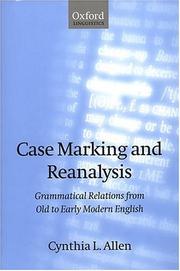
An edition of Case Marking and Reanalysis (1995)
Case Marking and Reanalysis
Grammatical Relations from Old to Early Modern English
By Cynthia L. Allen
Publish Date
May 17, 1999
Publisher
Oxford University Press, USA
Language
eng
Pages
519
Description:
It is commonly stated that the loss of case marking distinctions between Old and Middle English had profound consequences for the syntax of the language. In particular, linguists have attributed both the loss of the 'impersonal' constructions such as methinks and the introduction of new passives such as he was given a book directly to the loss of case marking distinctions. However the existing analyses generally suffer from empirical inadequacies: insufficient available information concerning the case marking systems (as opposed to the forms) makes it difficult to determine exactly when crucial marking distinctions disappeared. Dr Allen makes a careful examination of the primary evidence for how the loss of case distinctions proceeded, and of the temporal relationship between changes in morphology and particular syntactic changes. She demonstrates that morphological change had a less direct role in the triggering of syntactic change than is usually assumed, and that some changes traditionally considered to be the result of syntactic reanalysis are better treated in other ways. Some changes to grammatical relations were not the result of syntactic reanalysis, but were caused by changes in verbal semantics, while others which have been treated as syntactic reanalysis in fact involved no change to grammatical relations, but only to the possible case marking associated with subjects.
subjects: English language, Case, Morphology, English language, early modern, 1500-1700, English language, middle english, 1100-1500, grammar, English language, old english, ca. 450-1100, grammar, English language, word formation, English language, grammar, historical, Early modern, Middle English, Old English
Times: Early modern, 1500-1700, Old English, ca. 450-1100, Middle English, 1100-1500