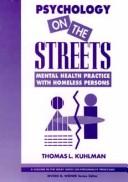
An edition of Psychology on the streets (1994)
Psychology on the streets
mental health practice with homeless persons
By Thomas L. Kuhlman
Publish Date
1994
Publisher
J. Wiley & Sons
Language
eng
Pages
223
Description:
What if, during an average Sunday dinner with friends at a local eatery, a disheveled-looking stranger suddenly sat down at your table and asked you how you were feeling? In all likelihood, your welcome would be less than warm. Yet, it is precisely in the role of the suspicious, uninvited guest that mental health practitioners usually appear in the lives of homeless people. Armed with good intentions but clueless about street culture, they arrive, hoping to win the trust and gratitude of people who haven't asked for their help. Psychology on the Streets grew out of psychologist Thomas Kuhlman's seven years of experience working with mentally ill street people of Madison, Wisconsin, and the Twin Cities area of Minnesota. Much like an anthropologist's field manual, this practical guide preps practitioners for the unique problems faced when working on the street. It schools them in the essential "dos and taboos" of street culture, while offering proven strategies for overcoming distrust and intervening effectively. Central to Dr. Kuhlman's "ecological" approach to working with street people is an awareness of the stresses of homelessness and the effect they can have on mental health, as well as a familiarity with the unique maladaptive reactions that homelessness spawns. With the help of dozens of telling vignettes based on actual clinical interactions, he sensitizes practitioners to the realities of life on the street while, at the same time, bringing into sharp focus the major cross-cultural obstacles to intervention. One practical consideration receiving particular attention is resistance-countertransference, a common problem among practitioners who, in their efforts to overcome client resistance and rejection, ally themselves too closely with homeless patients. Dr. Kuhlman offers a number of strategies for avoiding that problem, as well as guidelines to stress management and burnout prevention. Offering a wealth of practical guidelines and proven intervention strategies, Psychology on the Streets is an indispensable resource for psychologists, psychiatrists, social workers, and all mental health personnel who work with homeless persons either on the streets or in clinical settings.