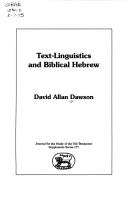
An edition of Text-linguistics and biblical Hebrew (1994)
Text-linguistics and biblical Hebrew
By David Allan Dawson
Publish Date
1994
Publisher
Sheffield Academic Press
Language
eng
Pages
249
Description:
"Modern linguistics is a relative newcomer in the scientific world, and text-linguistics, or discourse analysis, is one of its youngest disciplines. This fact has inclined many toward scepticism of its value for the Hebraist, yet much benefit is thereby overlooked. In this work, the author examines recent contributions to Hebrew text-linguistics by Niccacci, Andersen, Eskhult, Khan, and Longacre, evaluating them against a twofold standard of theoretical and methodological integrity, and clarity of communication. An extensive introduction to one particularly promising model of text analysis (from Longacre's tagmemic school) is given, and a step-by-step methodology is presented. Analyses according to this model and methodology are given of seven extended text samples, each building on the findings of the previous analyses: Judg. 2; Lev. 14.1-32; Lev. 6.1-7.37; parallel instructions and historical reports about the building of the Tabernacle, from Exodus 25-40; Judg. 10.6-12.7; and the book of Ruth in its entirety. Considerable attention is given to the question of text-linguistics and reported speech."--Bloomsbury Publishing Modern linguistics is a relative newcomer in the scientific world, and text-linguistics, or discourse analysis, is one of its youngest disciplines. This fact has inclined many toward scepticism of its value for the Hebraist, yet much benefit is thereby overlooked. In this work, the author examines recent contributions to Hebrew text-linguistics by Niccacci, Andersen, Eskhult, Khan, and Longacre, evaluating them against a twofold standard of theoretical and methodological integrity, and clarity of communication. An extensive introduction to one particularly promising model of text analysis (from Longacre's tagmemic school) is given, and a step-by-step methodology is presented. Analyses according to this model and methodology are given of seven extended text samples, each building on the findings of the previous analyses: Judg. 2; Lev. 14.1-32; Lev. 6.1-7.37; parallel instructions and historical reports about the building of the Tabernacle, from Exodus 25-40; Judg. 10.6-12.7; and the book of Ruth in its entirety. Considerable attention is given to the question of text-linguistics and reported speech
subjects: Linguistics, Style, Bible, Hebrew language, Language, style, Literaire structuur, Langue, Hébreu (Langue), Grammaire, Ruth (bijbelboek), Richteren (bijbelboek), Langue, style, Textual Criticism, Bibel, Hébreu (langue) biblique, Vertelkunst, Stylistique, Wetenschappelijke technieken, Textlinguistik, Critique textuelle, Syntax, Bible, language, style, Grammar, Bible as literature