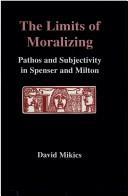
An edition of The limits of moralizing (1994)
The limits of moralizing
pathos and subjectivity in Spenser and Milton
By David Mikics
Publish Date
1994
Publisher
Bucknell University Press,Associated University Presses
Language
eng
Pages
271
Description:
This book argues that critical tradition has obscured the mutually constitutive relation between the didactic mission of Renaissance epic and the pathos of the epic self. Critics usually see Spenser and Milton either as poets dedicated to an autonomous aesthetic that dictates indulgence in pathos for its own sake, or as Christian moralists who subordinate pathos to the didactic demands of society. The Romantic tradition that stretches from Keats to Harold Bloom exemplifies the former option. Neo-Christian, reader response, and new historicist critics assert a contrary, but similarly unbalanced, view by choosing the didactic authority of social custom, tradition, or ideology over the pathos of subjectivity. Resisting attempts to establish an absolute priority for either pathos or moralizing, David Mikics looks to the debate between subjective passions and didactic imperatives as a sign of the complex relation between literary creation and social norms. In a study that shies away from new historicist endorsements of the force of normative ideology, as well as late Romantic celebrations of the poetic self, the author finds that Spenser and Milton develop an innovative literary subjectivity under the pressure of the Reformation's moralizing aims. Incorporating moral force within pathos would allow poetic passion to become a worthy and clearly justifiable public stance. But Spenser and Milton, in their pursuit of this rhetorical ideal, find themselves acknowledging, instead, an enduring disjunction between affect and the discursive forms of public morality which aim to discipline or exploit it.
subjects: English Epic poetry, English poetry, Ethics, Ethics in literature, History and criticism, Pathos in literature, Subjectivity in literature, Civil service, Periodicals, Didaktik, Pathos dans la litterature, Subjectiviteit, Morale dans la litterature, Ethiek, Poesie anglaise, Early modern, Histoire et critique, Morale, Poesie epique anglaise, Moralische Dichtung, Pathos, Subjectivite dans la litterature, Poésie anglaise, Poésie épique anglaise, Subjectivité dans la littérature, Pathos dans la littérature, Morale dans la littérature, Spenser, edmund, 1552?-1599, Milton, john, 1608-1674, religion and ethics, English poetry, history and criticism, early modern, 1500-1700, Epic poetry, history and criticism
People: Edmund Spenser (1552?-1599), John Milton (1608-1674)
Times: Early modern, 1500-1700