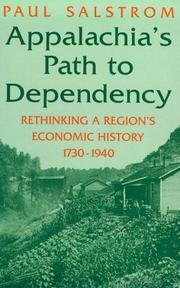
An edition of Appalachia's path to dependency (1994)
Appalachia's Path to Dependency
Rethinking a Region's Economic History, 1730-1940
By Paul Salstrom
Publish Date
February 1997
Publisher
University Press of Kentucky
Language
eng
Pages
204
Description:
The debate over the source of Appalachia's economic problems has been going strong since Harry Caudill's Night Comes to the Cumberlands appeared in 1963. Now a new study illuminates the region's plight, making a vital contribution to the understanding of this area's critical economic dilemma. In Appalachia's Path to Dependency, Paul Salstrom examines the evolution of economic life over time in southern Appalachia. Moving away from the colonial model to an analysis based on dependency, he exposes the complex web of factors - regulation of credit, industrialization, population growth, cultural values, federal intervention - that has worked against the region. Salstrom argues that economic adversity has resulted from three types of disadvantages: natural, market, and political. The overall context in which Appalachia's economic life unfolded was one of expanding United States markets and, after the Civil War, of expanding capitalist relations. Covering the entire span of Appalachia's economic history, from the early white settlement to the end of the New Deal, this work is not simply an economic interpretation but draws as well on other areas of history. Salstrom compares Appalachia with the Midwest at mid-nineteenth century, today's Appalachia with Third World countries, and the region with Japan. Whereas other interpretations of Appalachia's economy have tended to seek social or psychological explanations for its dependency, this important work compels us to look directly at the region's economic history. This regional perspective offers a clear-eyed view of Appalachia's path in the future.