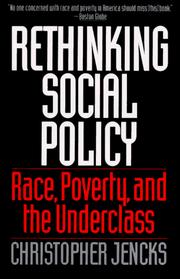
An edition of Rethinking social policy (1992)
Rethinking social policy
race, poverty, and the underclass
By Christopher Jencks
Publish Date
1993
Publisher
HarperPerennial
Language
eng
Pages
280
Description:
In a fervent appeal for clearer thinking on social issues, Christopher Jencks reexamines the way Americans think about race, poverty, crime, heredity, welfare, and the underclass. Arguing that neither liberal nor conservative ideas about these issues withstand close scrutiny, he calls for less emphasis on political principles and more attention to specific programs. Jencks describes how welfare policy was dominated in the early 1980s by conservatives who promoted ideas that justified cutting back sharply on the social programs of Lyndon Johnson's Great Society. They believed that a period of sustained economic growth, with low taxes and free markets, would do more to help poor people than coddling them with government assistance. Despite the economic expansion of the later Reagan years, however, the problems of persistent poverty grew even more serious. With clarity and a gift for apt analogy, Jencks analyzes major books on such subjects as affirmative action (Thomas Sowell), the "safety net" (Charles Murray), the effects of heredity on learning and propensity to commit crime (James Q. Wilson and Richard Herrnstein), ghetto culture and the underclass (William J. Wilson). His intention throughout is "to unbundle the empirical and moral assumptions that traditional ideologies tie together, making the reader's picture of the world more complicated"--In other words, to force us (readers and policymakers) to look at the way various remedial plans actually succeed or fail. For example, he believes that until we transform AFDC so that it reinforces rather than subverts American ideals about work and marriage, efforts to build a humane welfare state will never succeed. Other prescriptions, initially surprising and sometimes shocking, show demonstrable good sense once they are examined. As the author says, "If this book encourages readers to think about social policy more concretely, it will have served its primary purpose."
subjects: Government policy, Public welfare, Race relations, Social conditions, Social policy, United States, Urban poor, Asistencia pública, Pobreza urbana, Relaciones raciales, Política social, Relations interethniques, Aide sociale, Conditions sociales, Pauvres en milieu urbain, Politique sociale, Armoede, Relations raciales, Politique gouvernementale, Pauvreté, Sociale politiek, Rassenverhoudingen, United states, race relations, United states, social conditions, 1980-, United states, social policy, Public welfare, united states
Places: Government policy, United States, EE. UU, Política gubernamental
Times: 1980-