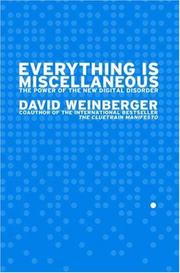
An edition of Everything Is Miscellaneous (2007)
Everything Is Miscellaneous
The Power of the New Digital Disorder
By David Weinberger
Publish Date
May 1, 2007
Publisher
Times Books
Language
eng
Pages
283
Description:
Human beings are information omnivores: we are constantly collecting, labeling, and organizing data. But today, the shift from the physical to the digital is mixing, burning, and ripping our lives apart. In the past, everything had its one place--the physical world demanded it--but now everything has its places: multiple categories, multiple shelves. Simply put, everything is suddenly miscellaneous. In Everything Is Miscellaneous, David Weinberger charts the new principles of digital order that are remaking business, education, politics, science, and culture. In his rollicking tour of the rise of the miscellaneous, he examines why the Dewey decimal system is stretched to the breaking point, how Rand McNally decides what information not to include in a physical map (and why Google Earth is winning that battle), how Staples stores emulate online shopping to increase sales, why your childrens teachers will stop having them memorize facts, and how the shift to digital music stands as the model for the future in virtually every industry. Finally, he shows how by going miscellaneous, anyone can reap rewards from the deluge of information in modern work and life. From A to Z, Everything Is Miscellaneous will completely reshape the way you think and what you know about the world.
subjects: Gestion des connaissances, Management, Personal information management, Gestion de l'information, Social aspects, Knowledge management, Ordre, Aspect social, Informationsmanagement, Information resources management, Elektronisches Informationsmittel, Gestion d'informations personnelles, Technologie de l'information, Wissensmanagement, Gestion, Order, Information technology, General, Knowledge Capital, Social Psychology, Social Science / General, Social Science, Psychology, Sociology, Information technology, management, Internet, social aspects, Information organization, Philosophy, Information society, Information Management, Knowledge