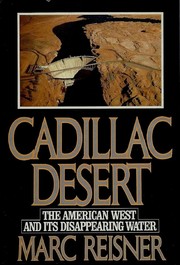
An edition of Cadillac desert (1986)
Cadillac desert
the American West and its disappearing water
By Marc Reisner
Publish Date
1993
Publisher
Penguin Books
Language
eng
Pages
582
Description:
"Beautifully written and meticulously researched."—St. Louis Post-Dispatch. This updated study of the economics, politics, and ecology of water covers more than a century of public and private desert reclamation in the American West. At its core, this book is a history of the massive engineering projects—dams, aqueducts, and diversions—that allowed the arid American West to bloom into a collection of major cities and agricultural hubs. It frames the development of the West not as a triumph of nature, but as a triumph of political maneuvering and federal spending. Why It Stands Out The "Money Flows Uphill" Thesis: Reisner famously argues that in the West, water doesn't follow the laws of physics; it follows the laws of money and power. He exposes how bureaucratic rivalries between the Bureau of Reclamation and the Army Corps of Engineers led to "pork-barrel" projects that were often economically irrational but politically unstoppable. Narrative Style: Unlike many dry academic texts on water law, Reisner writes with the pace of a political thriller. He paints vivid portraits of the "water titans"—the ambitious, often ruthless men who redirected entire rivers to create empires in the desert. Predictive Power: Although originally published in 1986, the book's warnings about the inherent limits of desert growth and the eventual "drying up" of the West are more relevant today than ever, particularly regarding the shrinking levels of the Great Salt Lake and Lake Mead. Key Highlights & Themes The Doctrine of Prior Appropriation: The book provides a masterful explanation of "First in time, first in right." This legal framework is the backbone of Utah’s water situation, where the first person to put water to "beneficial use" has a senior right that trumps everyone else, even in times of drought. The Central Utah Project (CUP): Reisner details the immense scale of the CUP, which was designed to divert water from the Colorado River basin into the Wasatch Front. It highlights the staggering cost and complexity of the infrastructure required to keep the region hydrated. The Myth of Abundance: A recurring theme is the "Great American Desert" vs. the "Garden of Eden" myth. Reisner explains how early settlers and developers convinced the public that "rain follows the plow," a misconception that fueled unsustainable growth patterns still felt today. An Alternative Perspective If you want something that focuses less on the history of dams and more on modern solutions, Water is for Fighting Over by John Fleck is a great companion. While Reisner focuses on the impending "disaster," Fleck highlights how cities like Salt Lake City and Las Vegas have actually managed to grow while decreasing their total water consumption through conservation and technology.