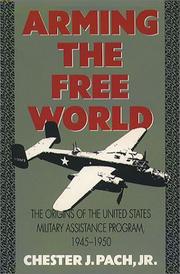
An edition of Arming the free world (1991)
Arming the free world
the origins of the United States military assistance program, 1945-1950
By Chester J. Pach
Publish Date
1991
Publisher
University of North Carolina Press
Language
eng
Pages
322
Description:
In this important study, Chester Pach traces the emergence of military assistance as a major instrument of contemporary American foreign policy. During the early Cold War, arms aid grew from a few country and regional programs into a world-wide effort with an annual cost of more than $1 billion. Pach analyzes the Truman administration's increasing reliance on arms aid - for Latin America, Greece and Turkey, China, and Western Europe - to contain Communist expansion during the late 1940s. He shows that a crucial event was the passage of the Mutual Defense Assistance Act of 1949, the progenitor of a long series of global, Cold War arms measures. Pach demonstrates that the main impetus for the startling growth of military assistance was a belief that it would provide critical political and psychological reassurance to friendly nations. Although this aid was obstensibly provided for military purposes, the overriding goals were insuring goodwill, raising foreign morale, stiffining the will to resist communism, and proving American resolve and reliability. -- from dust cover.