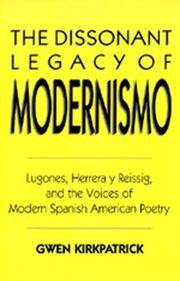
An edition of The dissonant legacy of modernismo (1989)
The dissonant legacy of modernismo
Lugones, Herrera y Reissig, and the voices of modern Spanish American poetry
By Gwen Kirkpatrick
Publish Date
1989
Publisher
University of California Press
Language
eng
Pages
312
Description:
In The Dissonant Legacy of MODERNISMO, Gwen Kirkpatrick offers a provocative new reading of a crucial and often misunderstood period of Spanish American literature. Most studies of modernismo have focused on the poetry of Rubén Darío and have noted the movement's aestheticism, distance from mundane concerns, and its unmistakable French influences. Kirkpatrick concentrates instead on important negations of harmony and the movement's internal dismantling of its own precepts. Major contradictions within the movement itself are revealed through the works of the Argentine Leopoldo Lugones and the Uruguayan Julio Herrera y Reissig. Extending her analysis to later writers such as Ramón López Velarde, César Vallejo, and Alfonsina Storni, Kirkpatrick shows the changes that foreshadow the more overt experiments of these poets and illuminates the continuity between the modernistas and later generations.^ Powerful statements by Latin American writers from the late nineteenth century to the present attest to the impact of modernismo. By showing the movement's bases in Romanticism and Symbolism, the author sets the stage for ironic and parodic disavowals by the dissonant modernistas, primarily Lugones and Herrera y Reissig. The particularly Spanish American context of a movement marked in so many ways by its derivative nature is revealed, and we see the poets confronting social and technological changes, shifting sexual mores, and technical poetical innovations. The passage from the harmonic world view proposed by Darío to vanguardism and a more modern poetry is one of the most debated topics in literary history. Asserting the need to rethink our catagories of literary convention, this book invites us to look once again at the poetry that formed a twentieth-century sensibility. In includes the dissonant voices of these modernistas.^ We can see in its contradictions and aggressiveness, its questionings of European authority, its physicality, its preoccupation with the urban scene, its exploration of language itself, poetic roots that continue to flourish in contemporary literary creation. -- Inside jacket flaps.
subjects: Criticism and interpretation, History and criticism, Modernism (Literature), Spanish American poetry, Latin american poetry, history and criticism, Romance literature, Critique et interprétation, POETRY, Continental European
People: Julio Herrera y Reissig (1875-1910), Leopoldo Lugones (1874-1938)
Places: Latin America
Times: 20th century