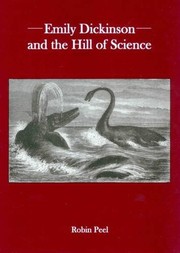
An edition of Emily Dickinson and the hill of science (2009)
Emily Dickinson and the hill of science
By Robin Peel
Publish Date
2009
Publisher
Fairleigh Dickinson University Press,UNKNO
Language
eng
Pages
435
Description:
"Emily Dickinson and the Hill of Science offers a new reading of Dickinson's poetry alongside the popular reporting of science in journals and newspapers available to Dickinson, and alongside the science textbooks in use in the schools Dickinson attended." "The first half of the nineteenth century was an exciting period in the development of science and technology, and the revelations of science and the technology it used (from microscope to telescope) not only provided exciting new ways of seeing the world, they did so in ways that were seized eagerly as evidence of revelation by New England Protestants. Science, no less than religion, inhabits the poems and is embedded in them, not only in the form of language and metaphor, but also in aspects of structure, and as strategies for addressing the subject of epistemology.^ Dickinson the scientist is not such a non sequitur as we might once have thought." "This fresh appraisal of Dickinson asks what happens when we shed all the assumptions we normally bring to the work of Emily Dickinson, and read her not as a poet, but as a concealed natural philosopher/ scientist, using parallel methodologies and inspired by the same questions as her contemporary scientists. It is a question that takes us away from the discussions of manuscript and individuality, for it involves assessing to what extent we might regard her poems as scientific, and as examples of writing that partake in a scientific discourse no less, or even more, than the religious or literary ones with which Dickinson's work is normally associated.^ Is it possible to sustain a reading that sees such startling original poems as not only deriving some of their qualities from the influence of the exciting new scientific culture, but as having scientific intentions, and making scientific claims?" "Answers to this provocative question are provided through chapters focusing on Dickinson and geology; Dickinson and geography; Dickinson, optics, and astronomy; and Dickinson, Darwin, and biology. Central to this discussion is a close examination of Dickinson's schooling in science, and her experience of the alliances between religion, science, and romanticism. In the final chapter Robin Peel argues that Dickinson's approach to the writing of verse parallels that of the amateur scientists of the day (and nearly all scientists were amateurs) in that her methodology of observing, recording, and cataloguing in fascicles corresponds to the procedures of empirical science.^ Such a reading provides a positive contemporary gloss on Dickinson's rejection of the literary marketplace, as the pure scientist is concerned only with knowledge, not fame."--Jacket.