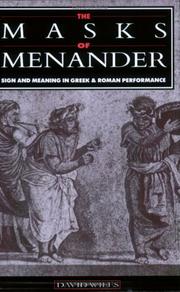
An edition of The Masks of Menander (1991)
The Masks of Menander
Sign and Meaning in Greek and Roman Performance
By David Wiles
Publish Date
June 3, 2004
Publisher
Cambridge University Press
Language
eng
Pages
283
Description:
This book provides a detailed analysis of the conventions and techniques of performance characteristic of the Greek theatre of Menander and the subsequent Roman theatre of Plautus and Terence. Drawing on literary nad archaeological sources, and on scientific treatises, David Wiles identifies the mask as crucial to the actor's art, and shows how sophisticated the art of the mask-maker became. He also examines the other main elements which the audience learned to decode: costume, voice, movement, etc. In order to identify features that were unique to Hellenistic theatre he contrasts Greek new comedy with other traditions of masked performance. A substantial part of the book is devoted to Roman comedy, and shows how different Roman conventions of performance rest upon different underlying assumptions about religion, marriage and class.
subjects: Classical drama (Comedy), History, History and criticism, Masks, Stage history, Theater, Classical drama, history and criticism, Theater, greece, Theater, rome, Theater, history, Menander, of athens, Plautus, titus maccius, Terence, Symbolic aspects, Masques
People: Menander of Athens, Terence, Titus Maccius Plautus
Times: To 500