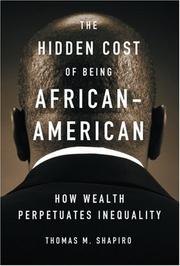
An edition of The hidden cost of being African American (2003)
The hidden cost of being African American
how wealth perpetuates inequality
By Thomas M. Shapiro
Publish Date
2004
Publisher
Oxford University Press
Language
eng
Pages
238
Description:
Thomas Shapiro blends personal stories, interviews, empirical data, and analysis to illuminate how family assets produce dramatic consequences in the everyday lives of ordinary citizens. This book will re-shape public understanding of racial inequality and will help us understand why new policies are necessary. Over the past three decades, racial prejudice in America has declined significantly and many African-American families have seen a steady rise in employment and annual income. Alongside these encouraging signs, Shapiro argues that fundamental levels of racial inequality persist, particularly in the area of asset accumulation. This book demonstrates how families use private wealth to leverage advantages in communities and schooling for themselves and their children. In this eye-opening volume, Shapiro uses a combination of in-depth interviews with almost 200 families from Los Angeles, Boston, and St.^ Louis, and national survey data with 10,000 families to show how racial inequality is passed down from generation to generation through the use of private family wealth. Shapiro adroitly illustrates the profound importance of assets--savings accounts, stocks, bonds, home equity, and other investments--to the past, present, and future lives of American families. For instance, young, white middle class-families typically purchase their first homes with substantial financial assistance from their extended family, and thus wealth accumulated from the past transforms opportunities into a substantial head start in life. This "wealthfare" is a legacy of past inequality visiting the present and may well project social injustice for generations into the future. An asset perspective, Shapiro shows, is a truer measure of the economic health of the black community--over half the black families fell below an asset poverty line in 1999.^ Moreover, an asset-based perspective, unlike currently used income-based approaches, gives insight into issues underlying debates ranging from school choice, welfare reform, and economic inequality.
subjects: African Americans, Economic aspects, Economic aspects of Racism, Economic conditions, Equality, Interviews, Race relations, Racism, Social conditions, Wealth, African Americans -- Economic conditions, African Americans -- Social conditions -- 1975-, Wealth -- United States, Equality -- United States, Racism -- Economic aspects -- United States, Interviews -- United States, United States -- Economic conditions -- 1981-2001, United States -- Economic conditions -- 2001-, United States -- Race relations -- Economic aspects, Noirs américains, Relations interethniques, Ungleichheit, Conditions sociales, Inégalité sociale, Aspect économique, Wirtschaftliche Lage, Conditions économiques, Economic history, African americans, economic conditions, African americans, social conditions
Places: United States