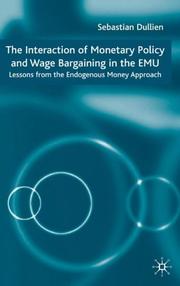
An edition of The interaction of monetary policy and wage bargaining in the European Monetary Union (2004)
Interaction of Monetary Policy and Wage Bargaining in the European Monetary Union
Lessons from the Endogenous Money Approach
By Sebastian Dullien
Publish Date
2004
Publisher
Palgrave Macmillan
Language
eng
Pages
276
Description:
"Sebastian Dullien gives a explanation for unemployment and inflation in the Euro-Zone. He argues that unemployment stems from a lack of cooperation between unions and monetary authorities. In an economy with endogenous money and monopolistic competition in good markets, the standard economic textbooks' distribution of macroeconomic responsibilities are turned upside down - wage setters are now responsible for price stability while the European Central Bank is responsible for level of output." "Only unions with a small and limited constituency can increase employment by simple wage restraint. However, this is shown to be a beggar-thy-neighbour policy, destroying employment elsewhere. On a European level, only when unions and the central bank cooperate can high employment and low inflation be achieved simultaneously. The institutional set-up with the 1999 Cologne process is found to be unable to assure such a cooperation."--BOOK JACKET.
subjects: Central Banks and banking, Collective bargaining, Economic and Monetary Union, Inflation (Finance), Monetary policy, Unemployment, Wages, Banks and banking, central, Monetary policy, europe, Wages, europe, Collective bargaining, europe, Inflation (finance), europe, Unemployment, europe
Places: European Union countries