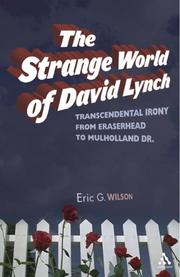
An edition of Strange World of David Lynch (2007)
The Strange World of David Lynch
Transcendental Irony from Eraserhead to Mulholland Dr.
By Eric G. Wilson
Publish Date
May 31, 2007
Publisher
Continuum International Publishing Group
Language
eng
Pages
185
Description:
Lynch's films place form and content in a perpetually self-consuming dialogue, as he vacillates endlessly between Hollywood conventions and avant-garde experimentation, placing viewers in the awkward position of not knowing when the image is serious and when it's in jest, whether the meaning is lucid or if it's been irrevocably lost. Irony exists in the gap between appearance and reality. The author posits that Lynch, through his frequent use of irony, unsettles traditional ideologies and throws viewers into a relentless interpretive limbo. Focusing in particular on Eraserhead, Blue Velvet, Wild at Heart, Lost Highway and Mulholland Dr., the author argues that Lynch's films are transcendental-pushing audiences into that borderland between equally valid, though thoroughly opposed, interpretations. By drawing viewers into this realm, these films invite ideas of a healing third term, a figure of synthesis that approximates traditional notions of self or soul. Hence, Lynch's pictures are, in this rather idiosyncratic fashion, religious. The book argues that the films of this remarkable director are lessons in how to escape the willful laws of society's demiurges and in how to participate in seemingly infinite possibility.