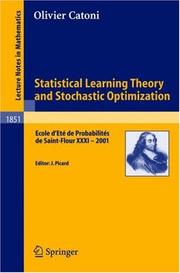
An edition of Statistical learning theory and stochastic optimization (2004)
Statistical learning theory and stochastic optimization
Ecole d'eté de probabilités de Saint-Flour XXXI, 2001
By Ecole d'été de probabilités de Saint-Flour (31st 2001)
Publish Date
2004
Publisher
Springer
Language
eng
Pages
272
Description:
Statistical learning theory is aimed at analyzing complex data with necessarily approximate models. This book is intended for an audience with a graduate background in probability theory and statistics. It will be useful to any reader wondering why it may be a good idea, to use as is often done in practice a notoriously "wrong'' (i.e. over-simplified) model to predict, estimate or classify. This point of view takes its roots in three fields: information theory, statistical mechanics, and PAC-Bayesian theorems. Results on the large deviations of trajectories of Markov chains with rare transitions are also included. They are meant to provide a better understanding of stochastic optimization algorithms of common use in computing estimators. The author focuses on non-asymptotic bounds of the statistical risk, allowing one to choose adaptively between rich and structured families of models and corresponding estimators. Two mathematical objects pervade the book: entropy and Gibbs measures. The goal is to show how to turn them into versatile and efficient technical tools, that will stimulate further studies and results.
subjects: Congresses, Mathematical statistics, Probabilities, Statistics, Mathematical optimization, Stochastic processes, Probabilités, Congrès, Statistique mathématique, Statistique, Statistiek, Stochastische methoden, Optimaliseren, Artificial intelligence, Mathematics, Numerical analysis, Distribution (Probability theory)