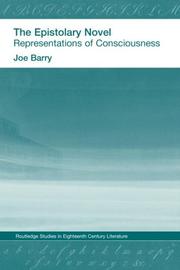
An edition of The epistolary novel (2003)
The epistolary novel
representation of consciousness
By Joe Bray
Publish Date
2003
Publisher
Routledge
Language
eng
Pages
160
Description:
"The epistolary novel is a form which has been neglected in most accounts of the stylistic development of the novel. This book argues that the way that the eighteenth-century epistolary novel represented consciousness had a significant influence on the later novel." "The letters studied here reveal complex tensions within the divided minds of their writers. The close stylistic analysis presented in this study suggests that the epistolary novel can probe individual psychology in sophisticated depth." "Critics have drawn a distinction between the self at the time of writing and the self at the time at which events or emotions were experienced. This book demonstrates that the tensions within consciousness are the result of a continual interaction between the two selves of the letter-writer. It charts the oscillation between these two selves in the epistolary novels of, amongst others, Aphra Behn, Eliza Haywood, Samuel Richardson, Fanny Burney and Charlotte Smith. The final chapter analyses the subtle way in which Jane Austen represents the consciousness of her characters and argues that, like many later novelists, Austen is indebted to the psychological tension and inner conflict which are characteristic of the epistolary novel."--Jacket.
subjects: Consciousness in literature, English Epistolary fiction, English fiction, History and criticism, English fiction, history and criticism, 18th century, Epistolary fiction, history and criticism, LITERARY CRITICISM, European, English, Irish, Scottish, Welsh, Briefromans, Engels, Zelf
Times: 18th century