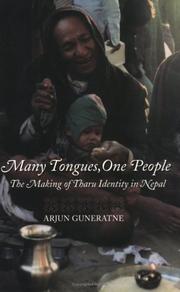
An edition of Many tongues, one people (2002)
Many tongues, one people
the making of Tharu identity in Nepal
By Arjun Guneratne
Publish Date
2002
Publisher
Cornell University Press
Language
eng
Pages
236
Description:
What Benedict Anderson, Paul Brass, Anthony Smith and Fredrik Barth share, despite their very different approaches to the analysis of ethnicity and national identity, is the assumption that somewhere at the bottom of it all is culture. A shared culture — or at least, some shared significant symbol — is seen as fundamental to ethnic identity, even though scholars disagree whether the culture is of ancient provenance or a ‘construct’ of modern times. This book challenges these notions: using the example of the Tharus of Nepal to illustrate his case, the author argues that ethnicity does not have to be predicated on shared cultural symbols. On the contrary, a sense of shared ethnic identity can come about among culturally dissimilar groups based on their common relationship to the state. The term Tharu is an ethnonym shared by a number of culturally and linguistically diverse people who only a few generations ago would not have acknowledged each other as belonging in the same ethnic group. Today, the Tharu are redefining themselves as a single ethnic group in Nepal's multi-ethnic polity. This process of ethnic redefinition is being led by the Tharu elite. The elite consists of landowners, schoolteachers and men with some education at the local village level and by politicians and government servants at the national level, who have organized themselves into an ethnic association known as the Tharu Welfare Association. A major portion of this book is devoted to a study of the Tharu Welfare Association, and to other more locally based Tharu ethnic organizations which are collectively promoting a sense of common identity that cuts across traditional intra-Tharu boundaries to fashion a meta-identity. The conjuncture of a number of forces has helped to shape the emergence of Tharu ethnicity. The first of these was the state building activities of the 19th century Nepali State, which sought to organize all of its subjects based on a common caste system. The state placed all Tharu groups, despite their unrelatedness, into a common category with common privileges and liabilities vis-a-vis ethnic groups in other categories. In the twentieth century, development projects carried out by the state brought immigrants in large numbers from other areas of Nepal into the lowlands occupied by Tharu groups. This not only reduced the Tharu to a minority, but also led to a substantial loss of land among them and in many areas reduced them to a position of quasi-serfdom. The relationship between Tharus and these immigrants, who are mostly of high caste, has been antagonistic. The primary experience that Tharus throughout the Tarai share to some degree or another is the experience of losing land to immigrants. Over a period of fifty years the Tharu elite has made its shared understanding of this situation the basis for common action in promoting an ethnic identity, and has established branches of the Tharu Welfare Association throughout Nepal. There is nothing primordial about the new ethnic consciousness described in this book. It is very clearly a product of modern forces. However, although the book favors modernist or deconstructionist interpretations of ethnicity, it offers a fresh insight in arguing that a shared culture is not a necessary condition of identity formation in a modern state. Insofar as the Tharu share a culture, it is the national culture of Nepal, and it is through the medium of that culture (and in particular its language) that Tharus are able creatively to imagine their peoplehood.
subjects: Ethnic identity, Tharu (South Asian people), Ethnology, nepal
Places: Nepal Tarai
Times: 19th to 20th centuries