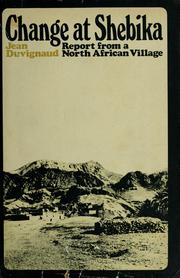
An edition of Chebika (1968)
Change at Shebika
report from a North African village.
By Jean Duvignaud
Publish Date
1970
Publisher
Pantheon Books
Language
eng
Pages
303
Description:
This is at once an intimate portrait of a Tunisian desert village, an evaluation of its potential and prospects for change, an analysis of the evolving relationship between researchers (including some citified Tunisian students) and researched, and an argument for Third World "social independence" (preserving the authenticity of villages like Shebika by utilizing their own capacity for transformation). Jean Duvignaud, a French leftist intellectual teaching sociology at the University of Tunis during the five years of this study, was attracted by Shebika's unconscious socialism--its ancient traditions and habits of communal life--as antidote to the aridity and fragmentation of the capitalist industrial societies. His enthusiasm for Shebika's collectivism led the villagers to "a new perception of their own values" and a climactic confrontation in "the incident of the quarry" with the paternalistic and insensitive regional Governorate. The portrayal of the village and villagers is not on the evocative order of Children of Sanchez; these subjects seem speech-shy and tend even when pressed to attribute all happenings to "God's will." But as an interpretive, consciously crafted study it offers much to consider re Shebika's specific situation and the social and psychological problems of development in new states.
subjects: Case studies, Rural conditions, Social conditions, Tunisia, Africa, rural conditions, Shabikah
Places: Shabīkah, Shabīkah (Tunisia), Tunisia