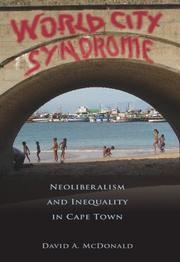
An edition of World City Syndrome (2007)
World City Syndrome
Neoliberalism and Inequality in Cape Town (Routledge Studies in Human Geography)
By David A. McDonald
Publish Date
October 16, 2007
Publisher
Routledge
Language
eng
Pages
384
Description:
Is Cape Town a world city? In many respects, yes. It fits the description of world cities laid out in the academic literature on the subject (albeit as a peripheral player) and has an increasingly complex global network of connections. But the academic description of a world city does not adequately capture or explore the dynamics of urbanization in Cape Town. As useful as this theoretical paradigm may be in describing the service-oriented, globally linked and polarized nature of the city, it fails to assess and address the key features of urban capitalist crisis that shape Cape Town and the neoliberal policies and institutions that have emerged as a result.
subjects: Economic conditions, Equality, Geography, Human geography, Neoliberalism, Politics and government, Racism, Social conditions, Urban Sociology, Urbanization, Human geography, africa, Sociology, urban, South africa, politics and government, South africa, economic conditions, South africa, social conditions, Néo-libéralisme, Urbanisation, Racisme, Sociologie urbaine, HISTORY, South, General, Republic of South Africa, Economic history, Stadtsoziologie, Ungleichheit, Neoliberalismus, Géographie humaine, Libéralisme, Égalité, Géographie, Politique et gouvernement, Conditions économiques, Conditions sociales, Liberalism, Nyliberalism, Jämlikhet, Stadssociologi
Places: Cape Town, Cape Town (South Africa), South Africa