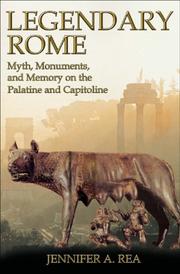
An edition of Legendary Rome (2007)
Legendary Rome
Myth, Monuments and Memory on the Palatine and Capitoline
By Jennifer Rea
Publish Date
July 13, 2007
Publisher
Duckworth Publishers
Language
eng
Pages
208
Description:
"'Legendary Rome' is the first book to offer a comparative treatment of the reinvention of Rome's origins in the poetry of Vergil, Tibullus and Propertius. It also examines the impact that the changing topography of Rome, as orchestrated by the emperor Augustus, had on those poets' renditions of Rome's legendary past. When the poets explore the significance of Augustus' reconstruction of the Palatine and Capitoline hills, they create new meaning and memories for the story of Rome's legendary foundations. As the tradition of Rome's mythic and legendary origins evolves through each poetic revision, the past transforms and is reinvented anew.The exploration of what constitutes a civilised landscape for each poet leads to significant conclusions about the dynamic and evolving nature of shared public memories. Written when Rome was in the process of defining a new, post-war identity, the poems studied here capture the growing tension between community and individual development, the restoration of peace versus expansion through military means, and stability and change within the city."--Bloomsbury Publishing. "Legendary Rome" is the first book to offer a comparative treatment of the reinvention of Rome's origins in the poetry of Vergil, Tibullus and Propertius. It also examines the impact that the changing topography of Rome, as orchestrated by the emperor Augustus, had on those poets' renditions of Rome's legendary past. When the poets explore the significance of Augustus' reconstruction of the Palatine and Capitoline hills, they create new meaning and memories for the story of Rome's legendary foundations. As the tradition of Rome's mythic and legendary origins evolves through each poetic revision, the past transforms and is reinvented anew.The exploration of what constitutes a civilised landscape for each poet leads to significant conclusions about the dynamic and evolving nature of shared public memories. Written when Rome was in the process of defining a new, post-war identity, the poems studied here capture the growing tension between community and individual development, the restoration of peace versus expansion through military means, and stability and change within the city
subjects: Literature and history, Rome, history, Literature, history and criticism, Literature and society, Latin poetry, History and criticism, Monuments in literature, Myth in literature, In literature, Architecture and state, Monuments, Virgil, Tibullus, Propertius, sextus, Monumentsaugustus , 63 b.c.-14 a.d, Literature and society--rome, Latin poetry--history and criticism, Literature and history--rome, Architecture and state--rome, Gedichten, Mythevorming, Stadsgezichten, Pa6047 .r43 2007