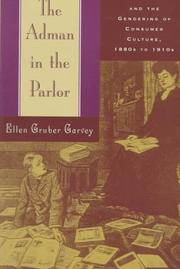
An edition of The adman in the parlor (1996)
The adman in the parlor
magazines and the gendering of consumer culture, 1880s to 1910s
By Ellen Gruber Garvey
Publish Date
1996
Publisher
Oxford University Press
Language
eng
Pages
230
Description:
How did advertising come to seem ordinary and even natural to turn-of-the-century magazine readers? The Adman in the Parlor explores readers' interactions with advertising during a period when not only consumption but advertising itself became established as a pleasure. Garvey's analysis interweaves such diverse texts and artifacts as advertising scrapbooks, chromolithographed trade cards and paper dolls, contest rules, and the advertising trade press. She argues that the readers' own participation in advertising, not top-down dictation by advertisers, made advertising a central part of American culture. As magazines became dependent on advertising rather than sales for their revenues, women's magazines led the way in turning readers into consumers through an interplay of fiction and advertising. General magazines, too, saw little conflict between editorial interests and advertising. Instead, advertising and fiction came to act on one another in complex, unexpected ways. Magazine stories illustrated the multiple desires and social meanings embodied in the purchase of a product. Advertising formed the national vocabulary. At once invisible, familiar, and intrusive, advertising both shaped fiction of the period and was shaped by it. The Adman in the Parlor unearths the lively conversations among writers and advertisers about the new prevalence of advertising for mass-produced, nationally distributed products.
subjects: American Short stories, American fiction, Attitudes, Books and reading, Economic aspects, History, History and criticism, Literature and society, Magazine Advertising, Periodicals, Popular literature, Publishing, Short stories, Women consumers, American fiction, history and criticism, 19th century, American fiction, history and criticism, 20th century, Short stories, american, history and criticism, Periodicals, publishing, Popular literature, history and criticism, Popular culture, united states, Advertising, Roman américain, Histoire et critique, Nouvelles, Édition, Histoire, Entreprises de presse, Aspect économique, Paralittérature, Nouvelles américaines, Littérature et société, Publicité dans les magazines, Consommatrices, LITERARY CRITICISM, American, General, American literature, history and criticism, 19th century, American literature, history and criticism, 20th century, Advertising, magazine, Consumers, American fiction--history and criticism, American fiction--19th century--history and criticism, Short stories--publishing--history, Short stories--publishing--united states--history--19th century, Periodicals--publishing--economic aspects, Periodicals--publishing--economic aspects--united states, Popular literature--history and criticism, Popular literature--united states--history and criticism, American fiction--20th century--history and criticism, Short stories, american--history and criticism, Literature and society--history, Literature and society--united states--history, Advertising, magazine--history, Advertising, magazine--united states--history, Books and reading--history, Books and reading--united states--history, Women consumers--attitudes, Women consumers--united states--attitudes, Ps374.s5 g34 1996, 813/.409
Places: United States
Times: 19th century, 20th century